Ecommerce website audit: what it covers and what it costs
What an ecommerce website audit covers, from a real purchase to AI assistants, and what it costs against margin, with the payback worked out.

An ecommerce website audit is a read of a store done the way a customer meets it: one real purchase, the store's own data, a comparison with stores already measured and a check of whether AI assistants name it. The price is the easy number. What it should be weighed against is the leak it finds.
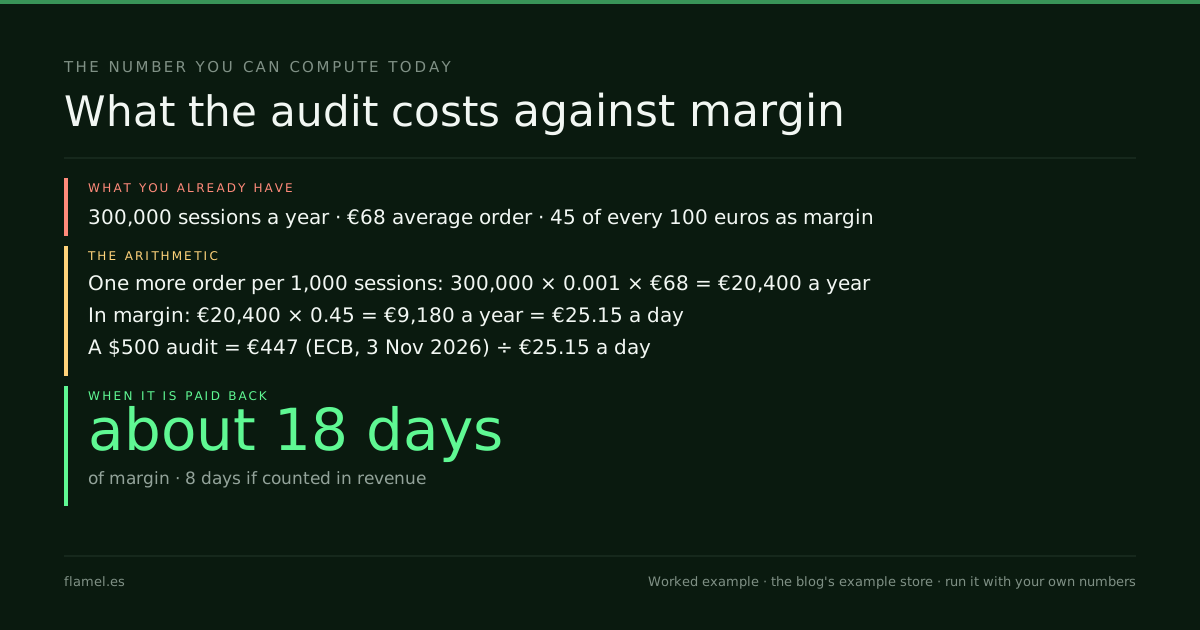
On the worked store this blog uses, 300,000 sessions a year at a €68 average order, one more order for every 1,000 sessions is worth €9,180 of margin a year. A $500 audit is about €447. It is paid back in about 18 days of that margin, not in a season.
Most audit checklists stop at speed and search. AI assistants are the newer gap. In October, 40 of every 100 stores Flamel's outreach audited did not appear in a single ChatGPT answer to shopping questions in their own category. A UX audit reads the design. This one reads the whole store.
An ecommerce website audit covers four things: a real purchase on a phone, the store's analytics and admin, a comparison with measured stores, and whether AI assistants recommend it. On a 300,000-session store at €68, one more order per 1,000 sessions is €9,180 of margin a year: a $500 audit pays back in about 18 days.
Key takeaways
- An ecommerce website audit reads the store as a customer meets it: a real purchase, the store's data, a comparison and an AI assistant asked to shop.
- Speed and SEO scanners are free. What costs money is the read: which few of many findings move orders.
- On the worked store, one more order per 1,000 sessions is €9,180 of margin a year, about €25 a day.
- A $500 audit, about €447, is paid back in about 18 days of that margin, or 8 days counted in revenue.
- This week: multiply annual sessions by 0.001 and the average order, apply the margin, divide by 365, then divide the audit's price by the result.
What an ecommerce website audit actually covers
Free scanners check speed and search. They read the code. They cannot buy anything.
A paid ecommerce website audit adds what only a person with access can do. It comes in four parts, and each one answers a question the store's own team is too close to ask.
1. A real purchase, on a phone
The audit starts the way a customer does: one real order, with a real card, on the device most customers use. Shopify supports this. Its help center says a store can "process an order using a real payment provider, and then immediately cancel and refund the order" (Shopify Help).
A simulated payment through the test gateway checks the plumbing. A real one shows what the shopper sees: the bank's screen, the delivery dates, the confirmation email.
The finding here is rarely a broken button. It is the moment the shopper hesitates: a shipping cost that appears at the last step, or a return policy hidden in the footer.
2. The store's own data, read together
Next come the numbers the store already has: analytics, the store admin and the email platform, read with the store's own access. Each tool reports on its own. The audit puts them side by side.
If analytics counts fewer purchases than the admin shows orders, every conversion rate built on analytics is off by the same gap. A store's ecommerce conversion rate is only as good as that match.
3. A comparison with measured stores
A number means little without a reference. The third part compares the store's funnel with stores already built and measured, step by step and with the same definitions.
Redi Foods, for example, is read on 130,465 sessions across 22 months. That is long enough to tell a good month from a real change.
4. An AI assistant, asked to shop
The last part is the newest. Shoppers ask ChatGPT what to buy, and an audit in 2026 checks whether the store is in the answer. An AI agent gets the shopper's question and shops the category.
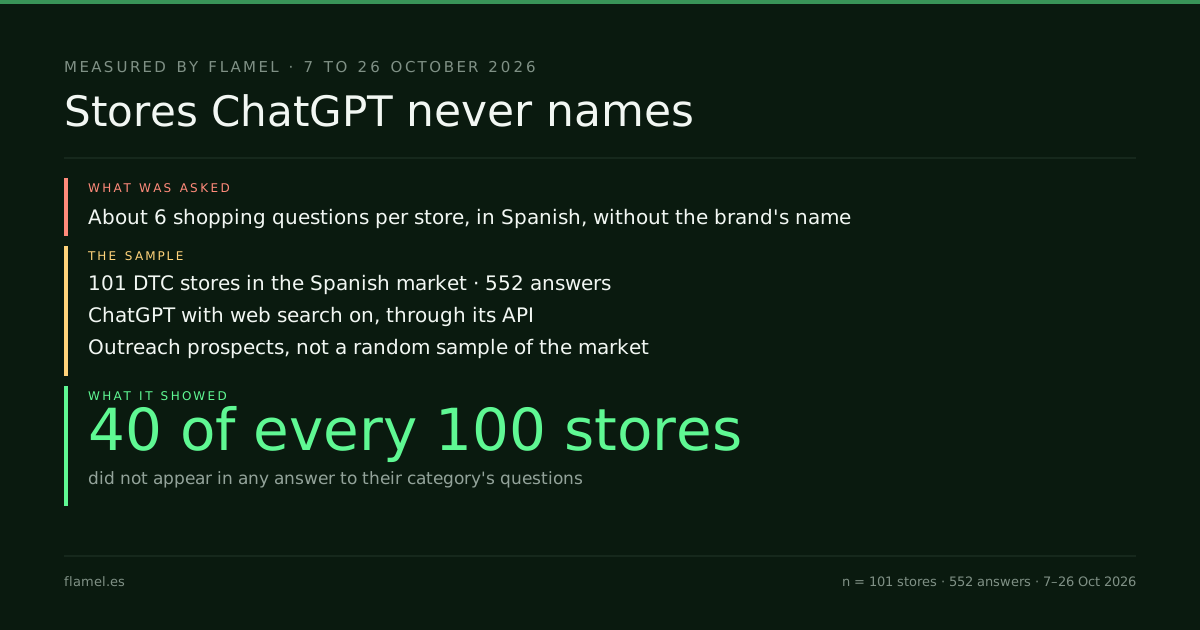
In October, Flamel's outreach ran this test on 101 direct-to-consumer stores in the Spanish market: about six shopping questions per store, asked of ChatGPT with web search on, without naming the brand. 40 of every 100 stores did not appear in any answer. The sample is not random. These are stores the outreach chose, and the questions were written to find gaps. It is a reading of 101 stores, not a market average.
One possible cause is easy to rule out. OpenAI says OAI-SearchBot "is used to surface websites in search results in ChatGPT's search features", and that sites opted out of it "will not be shown in ChatGPT search answers, though can still appear as navigational links" (OpenAI). An old robots.txt rule against bots can be enough to block it.
What the ecommerce website audit hands back
Four parts in, four things out:
- a screen-recorded walkthrough of 15 to 20 minutes, covering every leak found;
- a one-page roadmap in red, amber and green, by priority;
- a live review session to decide what happens next;
- a living document, kept up to date for 30 days.
The order matters more than the length. Forty findings with no ranking leave the team where it started. Three findings ranked by what they cost tell it where to begin.
What an ecommerce website audit costs, against margin
The Conversion Audit costs $500 and takes five business days. At the European Central Bank's reference rate of 3 November 2026, 1.1179 dollars per euro (European Central Bank), that is about €447. The question is what it is weighed against.
Take the worked store this blog uses, as an example: 300,000 sessions a year, a €68 average order, 1 order for every 100 sessions and 45 of every 100 euros as margin. One more order for every 1,000 sessions, from 1 per 100 to 1.1, is a tenth of a conversion point.
Revenue per tenth = 300,000 × 0.001 × €68 = €20,400 a year
Margin per tenth  = €20,400 × 0.45        = €9,180 a year
Margin per day    = €9,180 ÷ 365          = €25.15
Payback           = €447 ÷ €25.15         ≈ 18 days
Counted in revenue, €55.89 a day, the same audit is paid back in 8 days. Counted in margin, the money the store keeps, it takes about 18. The second is the one to plan with.
The audit does not promise that tenth of a point. It says where to look for it, and in what order.
See what the Conversion Audit reads in five business days.
A one-off audit sits next to monthly options. An ecommerce consultant at ten hours a month costs the same store €12,360 a year. An ecommerce growth agency fee is weighed against revenue the same way. The audit is the step before either: it says what those hours should be spent on.
What an ecommerce SEO audit leaves out
An ecommerce SEO audit is a different job. Google describes SEO as "helping search engines understand your content, and helping users find your site and make a decision about whether they should visit your site through a search engine" (Google Search Central).
That ends at the visit. A website audit starts there: what happens between the landing page and the order confirmation. Both matter. A store can rank well and still lose its visitors at checkout, and an SEO audit will pass it. Ecommerce conversion rate optimization maps where that revenue leaves.
The payback number for your store
Margin per day = annual sessions × 0.001 × average order × margin ÷ 365
Payback days   = audit price ÷ margin per day
Under 30 days, a single tenth of a point found and fixed covers the audit inside a month.
What to do by Monday: take last year's sessions, average order and margin from the store admin, and run the two lines above. Then place one real order on a phone, with a real card, and refund it. That is part one of the audit, and it costs the payment processor's fee on one refunded order.
Work through this with your own numbers
I run an online store with [annual sessions] sessions a year, an average order of [average order], [orders per 100 sessions] orders for every 100 sessions and [margin per 100 euros] euros of margin for every 100 euros of revenue. Calculate what one more order for every 1,000 sessions is worth: annual sessions × 0.001 × average order = revenue per year; times the margin = margin per year; divided by 365 = margin per day. Then divide the price of the audit I am considering, [audit price], by the margin per day to get the days it takes to pay back. Then take my list of known problems, [problems], and sort each one into four areas: the purchase, the store's data, the comparison with other stores, and AI assistants. Tell me which area I have never checked. Show every step of the arithmetic.FAQ
How much does an ecommerce website audit cost?
Free scanners cost nothing and check speed and search. A paid audit that buys from the store and reads its data is a fixed fee. The Conversion Audit is $500, about €447, credited in full against a project if there is one.
What does an ecommerce website audit include?
Four parts: a real purchase on the device customers use, the store's analytics, admin and email read together, a comparison with stores already measured, and an AI assistant asked to shop the category. It ends in a ranked list of what to fix first.
How long does an ecommerce website audit take?
A focused audit takes five business days from signature. Ordered on a Wednesday, the map is back the following Wednesday, which leaves time to fix the first items before a peak like Black Friday on 27 November.
Is an ecommerce SEO audit the same as a website audit?
No. An SEO audit checks whether search engines understand the store and send visitors to it. A website audit starts where that ends: what happens to those visitors between the landing page and the order confirmation.
The Conversion Audit buys from your store and reads it in five business days: $500, credited in full against a project if there is one, and the map stays with you either way.
Your store, five days.
$500. Zero commitment. Yours either way.
Made between
Barcelona and Bogotá.
What’s holding your store’s sales back, in minutes.
Free, no card. Shopify stores for now.