SaaS quick ratio: how to calculate it, leaks first
The SaaS quick ratio divides new and expansion MRR by churned and contraction MRR. How to calculate it, worked on a product, and why leaks come first.

The SaaS quick ratio divides the recurring revenue a product adds in a month by the recurring revenue it loses. The formula: quick ratio = (new MRR + expansion MRR) ÷ (churned MRR + contraction MRR). Above 1 the product grows. At 1 it stands still. Below 1 it shrinks, even while it signs up customers.
Half of the ratio is marketing's: new MRR. The other half, the denominator, is product's: what leaves. A team that only pushes acquisition is working on one side of the fraction.
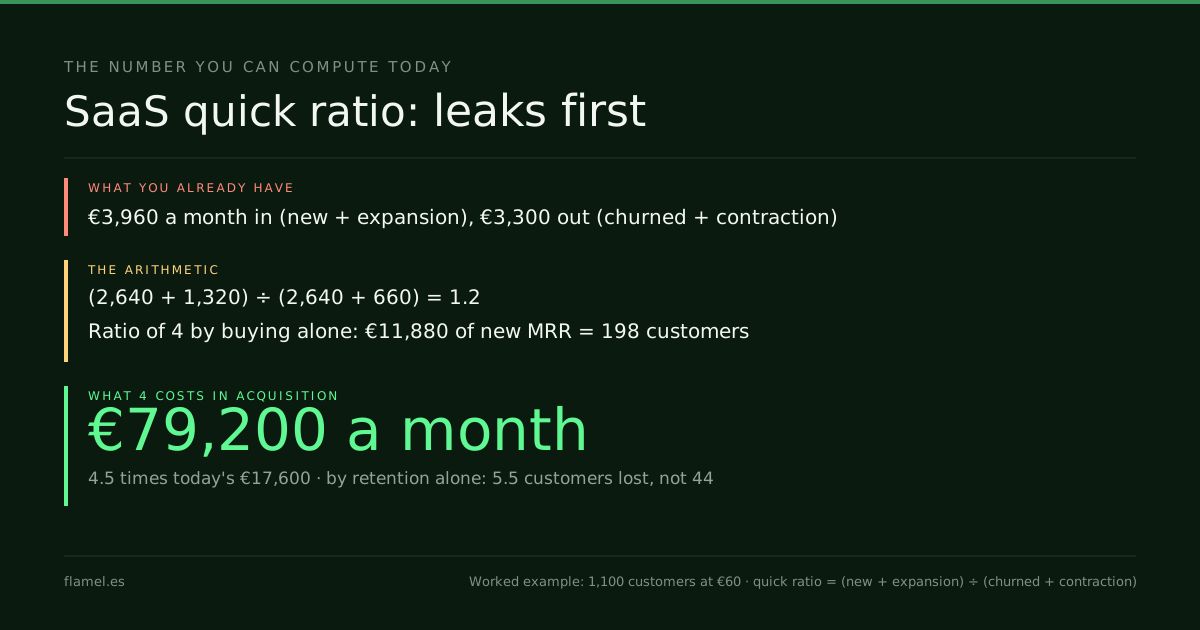
The SaaS quick ratio is (new MRR + expansion MRR) ÷ (churned MRR + contraction MRR). Above 1 a product grows, and 4 is the commonly cited target. On a product adding €3,960 and losing €3,300 a month, it is 1.2. Reaching 4 by acquisition alone would take €79,200 of acquisition a month.
Key takeaways
- The SaaS quick ratio is new plus expansion MRR divided by churned plus contraction MRR. Above 1 the product grows; 4 is the commonly cited target.
- On the example product, (€2,640 + €1,320) ÷ (€2,640 + €660) = 1.2: almost every euro acquired refills one that left.
- Reaching 4 by acquisition alone takes 198 new customers and €79,200 a month, 4.5 times today's spend.
- Twice the acquisition and half the churn both give 2.0. The first costs €17,600 more every month.
- This week: calculate the last three months' ratio, then again with half the churned MRR, and price both moves.
The SaaS quick ratio formula, line by line
Quick ratio = (new MRR + expansion MRR) ÷ (churned MRR + contraction MRR)

new MRR         = recurring revenue from customers who started paying this month
expansion MRR   = what existing customers added: upgrades, seats, add-ons
churned MRR     = what left with the customers who canceled
contraction MRR = what existing customers removed by moving to a cheaper plan
ChartMogul's metrics library uses the same formula and reads it the same way: above 1 "the business is growing", exactly 1 means MRR is "roughly flat", and below 1 it is shrinking. It calls a ratio of 4 "a commonly cited healthy target": four euros of MRR gained for every euro lost (ChartMogul).
The four lines are the same ones behind net new MRR. Net new MRR subtracts them. The quick ratio divides them.
The SaaS quick ratio on the example product
Take the product this blog's SaaS posts use: 1,100 paying customers at €60 a month, €66,000 of MRR. Marketing brings 44 new customers a month at €400 each: €2,640 of new MRR for €17,600 of acquisition. Every month 4 of every 100 customers leave, the rate SaaS churn rate works through: 44 customers, €2,640. The customers who stay add €1,320 and remove €660, the declared figures of net revenue retention.
Quick ratio = (2,640 + 1,320) ÷ (2,640 + 660)
            = 3,960 ÷ 3,300
            = 1.2
For every euro that leaves, €1.20 comes in. Almost every euro acquired refills one that leaked.

Reaching 4: acquisition or leaks
There are two ways to move a fraction. On the example product, both are steep.
By acquisition alone:
  gains needed   = 4 × 3,300           = €13,200
  new MRR        = 13,200 − 1,320      = €11,880 = 198 customers
  acquisition    = 198 × €400          = €79,200 a month (4.5 × €17,600)

By retention alone:
  losses allowed = 3,960 ÷ 4           = €990
  churned MRR    = 990 − 660           = €330 = 5.5 customers instead of 44
Neither is a plan for one quarter. The middle shows the trade better:
Twice the acquisition: (5,280 + 1,320) ÷ 3,300 = 2.0
Half the churn:        (2,640 + 1,320) ÷ 1,980 = 2.0
The ratio is the same. The bill is not. Twice the acquisition costs €17,600 more every month, for as long as it runs. Half the churn costs whatever it takes to keep 22 customers a month who were leaving. Reduce churn prices today's replacement of those leaks at €211,200 a year.
Why the SaaS quick ratio reads leaks first
Andrés Ossa, CEO of Flamel, wrote on LinkedIn in October that a request from sales usually gets prioritized because it looks closer to revenue, and that in reality it isn't always. The quick ratio puts the other half in the same number. On the example product, marketing buys 44 customers a month and the product loses 44. Before buying more of the top line, read the bottom one: who left, on which plan, after how many months.
Customer retention rate counts the same leak in customers instead of euros.
What a good SaaS quick ratio depends on
The size of the base. ChartMogul warns that on a small MRR base, "a single large customer churning, or a single large expansion deal closing, can swing the Quick Ratio dramatically from one month to the next". On the example product, one customer is €60 against €3,300 of monthly losses, so one month says a lot. On a product with 40 customers, read three months together.
The ratio also hides the size of the two flows. 1.2 from €3,960 in and €3,300 out is a different product from 1.2 with a tenth of both. SaaS metrics reads it next to the other numbers of the year.
The SaaS quick ratio number for your product
Quick ratio            = (new + expansion) ÷ (churned + contraction)
New MRR needed for 4   = 4 × (churned + contraction) − expansion
Churned MRR allowed    = (new + expansion) ÷ 4 − contraction
On the example product: 1.2 today, and €79,200 of acquisition a month to reach 4 by buying alone.
What to do by Monday: pull the last three months of the four MRR lines from billing. Calculate the ratio each month, then again with half the churned MRR. Put next to it what the same ratio would cost in acquisition.
Work through this with your own numbers
My SaaS product's billing shows, for each of the last three months: [new MRR], [expansion MRR], [churned MRR], [contraction MRR], [new customers] and [acquisition spend]. Calculate the quick ratio each month as (new + expansion) ÷ (churned + contraction), and say whether the product grew, stood still or shrank. For the latest month, calculate my CAC as acquisition spend ÷ new customers. Then calculate how much new MRR, how many new customers and how much acquisition spend it would take to reach a ratio of 4 with churn unchanged. Then calculate how far churned MRR would have to fall to reach 4 with acquisition unchanged. Finally, compare doubling acquisition with halving churned MRR: give the ratio and the extra monthly acquisition cost of each. Show every step of the arithmetic.FAQ
What is a good SaaS quick ratio?
A ratio of 4, four euros of MRR gained for every euro lost, is the commonly cited healthy target. Above 1 the product grows, at 1 it stands still and below 1 it shrinks. On a small customer base, read several months together.
How do you calculate the SaaS quick ratio?
Add new MRR and expansion MRR, then divide by churned MRR plus contraction MRR. With €2,640 of new MRR, €1,320 of expansion, €2,640 of churn and €660 of contraction, the ratio is 3,960 ÷ 3,300 = 1.2.
Why does the quick ratio jump from month to month?
Because it divides two monthly flows. On a small base, one large customer leaving or one large upgrade can swing it on its own. Average three months before acting on a single reading.
What is the difference between the quick ratio and net new MRR?
They use the same four lines. Net new MRR subtracts losses from gains; the quick ratio divides them. A product can show €660 of net new MRR and a ratio of only 1.2 in the same month.
If the ratio is stuck near 1 and you don't know which side to work on first, the Activation Audit maps where activation breaks in five business days, for $500, and the map stays with you whether or not you hire anyone.
Your store, five days.
$500. Zero commitment. Yours either way.

Made between
Barcelona and Bogotá.
What’s holding your store’s sales back, in minutes.
Free, no card. Shopify stores for now.