Black Friday checklist: 10 checks before the traffic
A Black Friday checklist in 10 checks, in the order a shopper meets the store, and what a failing checkout costs on the day. Worked example.

A Black Friday checklist is the short list of what has to work before the paid traffic lands, checked in the order a shopper meets the store. Measurement is the check most lists leave out, and it decides what the season teaches. The Redi Foods rebuild is read on 130,465 sessions across 22 months, not on one weekend.
Black Friday falls on 27 November this year. When everything seems urgent, Andrés Ossa, CEO of Flamel, wrote on LinkedIn in October, is when a team has to be most methodical. A checklist is that method. Ten checks, two for each moment of the visit: being found, being served, being recognized, being kept and being measured.
Each one is cheap in the first weeks of November. A fault found then costs an afternoon. The same fault found on the Friday costs the day's orders, and those sessions cannot be bought back.
Before the list: the Conversion Audit reads the whole visit of a store in five business days, for $500. Ordered by 16 November, the map is back before Black Friday week.
A Black Friday checklist covers ten checks before the traffic: the promotional price in the feed, AI search access, page speed, a real test order, the discount, the order emails, stock, early access, purchase tracking and a baseline week. On a 3,000-session Friday, a failing checkout loses 30 orders: €1,632.
Key takeaways
- A Black Friday checklist follows the visit: found, served, recognized, kept and measured, with two checks for each moment.
- Every check is cheap in early November: a fault found then costs an afternoon, not a day of orders.
- On the worked store, a checkout that fails on a 3,000-session Friday loses 30 orders: €1,632 of revenue and €510 of margin.
- In Europe, a card payment can stop at the bank's screen, so the test order is worth making with a real card.
- This week, place one real order on a phone, watch it land in analytics, and write down the normal week before the promotion.
What a Black Friday checklist is for
The Black Friday checklists that rank run to 27, 30 or 52 items. Length is not the problem. Order is. A store cannot fix everything in three weeks, and some faults cost far more than others on the day.
The ten checks below follow the visit, two per moment. Ecommerce conversion rate optimization covers where revenue leaves a store in any month. This is the version for the three weeks before the peak. The Black Friday posts on this blog go deeper on the discount, page speed, stock and early access. Here they only get a date.
1. The product feed shows the promotional price
Shopping ads and free listings read the product feed, not the page. Google Merchant Center asks stores to "submit an amount and currency that match the price on your landing page and the checkout pages" (Google Merchant Center Help). A promotional price has its own attribute, and it shows as the current price during the dates the store sets.
The check: every discounted product carries its promotional price and its dates in the feed before the banner goes live. A feed that still shows the full price sends the shopper to a page that says something else.
2. AI search can read the store
ChatGPT has its own search, and it leaves out the stores that block its crawler. OpenAI says OAI-SearchBot "is used to surface websites in search results in ChatGPT's search features", and that "sites that are opted out of OAI-SearchBot will not be shown in ChatGPT search answers" (OpenAI).
The check: the store's robots.txt does not block OAI-SearchBot. A rule written years ago against bots can keep the store out of those answers in the one month that matters.
3. The landing pages load on a phone
The pages a campaign sends traffic to carry the whole week. The check: each one, opened on a phone, on mobile data, not on the office wifi. Page speed and conversion rate prices one second in the same peak month on the worked store: €4,420.
4. A real order goes through
Shopify lets a store simulate a payment through its "Test payment gateway". It also says a store can "process an order using a real payment provider, and then immediately cancel and refund the order" (Shopify Help). The second runs the same payment a customer will.
In Europe that includes the bank. The EU's second Payment Services Directive requires strong customer authentication when the payer "initiates an electronic payment transaction" (PSD2, Article 97). The check: one real order, on a phone, with a real card from the country that buys most, refunded the same day. Watch what the bank asks for. This is the check the arithmetic at the end is about.
5. The discount is priced and the same everywhere
A discount changes how many orders a week needs. At 20 off, the worked store needs 1.8 times the orders to earn the same margin, as Black Friday discount strategy works out. Set the depth from that number, not from what competitors announce.
Then read the offer the way a shopper meets it: the ad, the landing page, the cart and the email, in a row, on a phone. Same discount, same end date, same conditions. A shopper who reads 25 off in the ad and 20 off in the cart has to decide which one is true at the moment of paying.

6. The order emails look like the store
The confirmation and shipping emails are the first thing a new customer receives. The check: a test order's emails carry the store's name and look, and the delivery dates they promise are the real ones for the peak week, not the usual ones.
7. The best sellers have the stock
The products that sell most in a normal month sell out first in the peak. Black Friday inventory planning sizes the order from peak sessions and conversion: 500 orders and 750 units in the worked store's peak month. The check: the top ten products against that number, and a decision now about what the page says when one runs out.
8. Past buyers hear first
The customers who already bought are the cheapest orders of the week. Black Friday early access works it out on the same store: past buyers are one in five recipients and bring two in three orders. The check: the list is segmented, the early-access email is scheduled, and its link opens the right page.
9. One order shows up as one purchase
Measurement breaks quietly. Google Analytics' Realtime report lets a store "monitor activity on your website or app as it happens" (Google Analytics Help). The check: the real order from check 4 arrives there as one purchase, with the right value. Then a full day of purchases in analytics is compared with the orders in the store. If the two disagree before the peak, the peak cannot be read.
10. The baseline is written before the promotion
A week of 120 orders says nothing on its own. Promotion incrementality splits it on the worked store: 58 orders would have come anyway, and the two weeks after run 26 orders short. The check: the normal week's orders, sessions and conversion, written down now, before the promotion moves them. Without them, next year's plan starts from zero.
The Black Friday checklist on one page
| # | Check | Moment | Done by |
|---|---|---|---|
| 1 | Promotional price and dates in the feed | Found | Before the banner |
| 2 | OAI-SearchBot allowed in robots.txt | Found | This week |
| 3 | Landing pages opened on a phone | Served | Before the ads |
| 4 | One real order, real card, refunded | Served | This week |
| 5 | Discount priced, offer identical everywhere | Recognized | Before the banner |
| 6 | Order emails with the store's look and real dates | Recognized | This week |
| 7 | Stock for the top ten products | Kept | This week |
| 8 | Early access for past buyers | Kept | A week before |
| 9 | One order = one purchase in analytics | Measured | This week |
| 10 | Baseline week written down | Measured | Before the promotion |
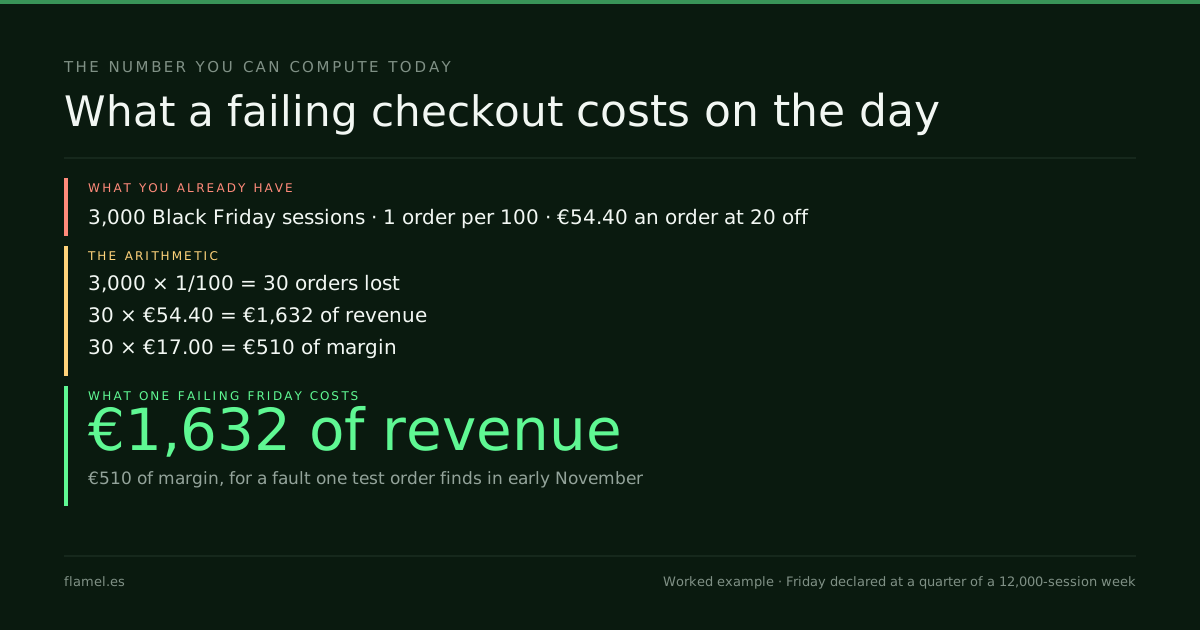
What a failing checkout costs on the day
Orders lost  = the day's sessions × conversion
Revenue lost = orders lost × discounted order
Margin lost  = orders lost × margin per discounted order
The worked store this blog uses, as an example: 300,000 sessions a year, a €68 average order, 1 order for every 100 sessions and 45 of every 100 euros as margin. Its Black Friday week is declared at the 120 orders of the incrementality post, which at 1 order per 100 sessions means 12,000 sessions. Friday is declared at a quarter of that week: 3,000 sessions. At 20 off, an order sells for €54.40 and earns €17.00.
Orders lost  = 3,000 × 1/100 = 30
Revenue lost = 30 × €54.40  = €1,632
Margin lost  = 30 × €17.00  = €510
That is the price of finding check 4 on the day. Found in the first week of November, the same fault costs one refunded order.
What to do by Monday: run checks 4 and 9 together. One real order, with a real card, on a phone, watched as it lands in analytics, then refunded. Put the other eight on a calendar, each with a date before 27 November.
A season is read over months, not one weekend. Redi Foods is measured on 130,465 sessions across 22 months.
Work through this with your own numbers
I run an online store with [orders per 100 sessions] orders for every 100 sessions, an average order of [average order] and [margin per 100 euros] euros of margin for every 100 euros of sales. On Black Friday I expect [Black Friday sessions] sessions and a discount of [discount]. Calculate what one day of a failing checkout would cost: orders lost = Black Friday sessions × conversion; revenue lost = orders lost × discounted order value; margin lost = orders lost × margin per discounted order. Then take this checklist and its status: [the ten checks, done or not]. For each check not yet done, estimate the hours it takes and give it a date before [Black Friday date], with the real test order and the purchase tracking first. Show every step of the arithmetic.FAQ
What should be on a Black Friday checklist?
Ten checks in the order a shopper meets the store: the promotional price in the product feed, access for AI search, landing pages on a phone, a real test order, the discount priced and stated the same everywhere, the order emails, stock, early access for past buyers, purchase tracking and a baseline week.
When should a store start preparing for Black Friday?
Early enough for each check to fail and be fixed. In the first weeks of November a fault costs an afternoon. On the day, a failing checkout on a 3,000-session Friday loses 30 orders: €1,632 of revenue at 20 off.
How do you test a checkout before Black Friday?
Place a real order with a real card, on a phone, then cancel and refund it. Shopify supports both a test payment gateway and a real order refunded at once. In Europe, the real order also shows the bank's authentication step.
How do you know if Black Friday worked?
Compare the week with a baseline written down before the promotion. On the worked store, a 120-order week holds 58 orders that would have come anyway, and the two weeks after run 26 orders short, so the promotion created only part of the week.
The Conversion Audit reads the whole visit before the peak: five business days, $500, and the map stays with you whether or not you hire anyone next.
Your store, five days.
$500. Zero commitment. Yours either way.

Made between
Barcelona and Bogotá.
What’s holding your store’s sales back, in minutes.
Free, no card. Shopify stores for now.